
"Hiroshima-style okonomiyaki is completely different from what you get in Osaka — it's layered, not mixed, and the noodles inside make it a proper meal. I ate it three times in two days. No regrets."
Hiroshima Okonomiyaki
Hiroshima okonomiyaki is a savoury Japanese pancake layered on a hot griddle — batter, shredded cabbage, pork belly, yakisoba noodles and a fried egg, each added separately and cooked at 170°C to 200°C. The result is a complete meal with distinct textures in every layer. Hiroshima has over 2,000 restaurants that specialize in okonomiyaki, more than any other city in Japan.
The dish emerged in the 1950s from post-war food scarcity — minimal flour, maximum vegetables. Mitsuo Ise, known as Mitchan Sōhonte, is considered the father of Hiroshima-style okonomiyaki. What began as a cheap street food became the defining dish of Hiroshima. Today it is the most important thing to eat when you visit.
Hiroshima Style Okonomiyaki vs Osaka Style
Hiroshima-style okonomiyaki and Osaka-style okonomiyaki are two completely different dishes that share a name. In Osaka, all the ingredients — flour, egg, cabbage, pork — are mixed into the pancake batter before cooking and then grilled as a single mass. In Hiroshima, each ingredient is layered separately on the hot plate. Layering ingredients results in a lighter texture compared to Kansai-style.
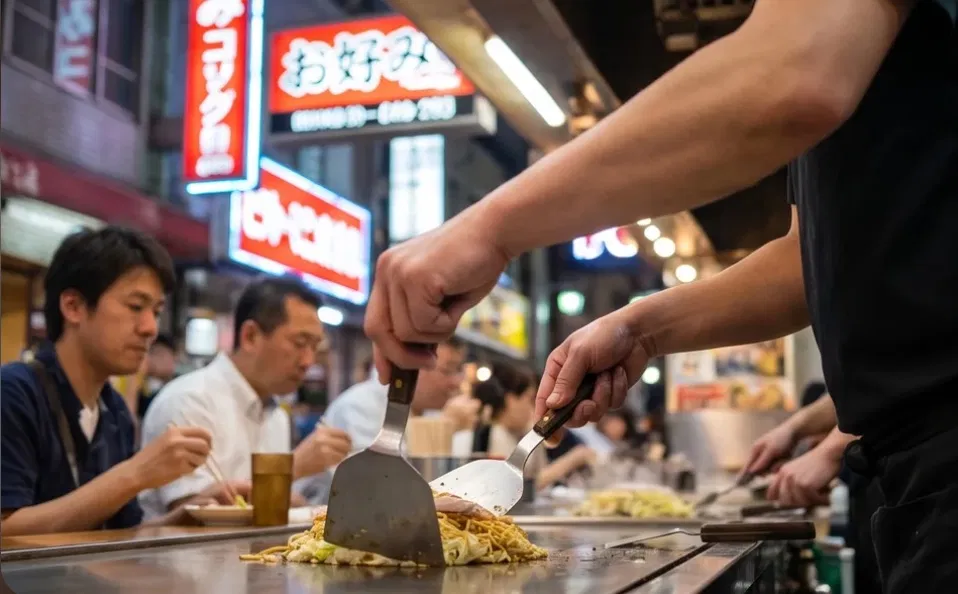
The key difference in Hiroshima style: a thin circle of batter is quickly spread on the griddle first, then shredded cabbage is piled about 8cm tall on top and steamed during cooking, becoming sweet. Pork belly goes on the cabbage, then the whole stack is flipped with two spatulas. Yakisoba noodles are cooked separately on the same hot plate, then the pancake stack is placed on top of the noodles. A fried egg — cracked directly onto the griddle — goes underneath at the end, and the whole construction is flipped once more onto the egg.
Hiroshima-style okonomiyaki is bigger, more filling and more structurally complex than Osaka style. The pancake batter uses about 100g of cake flour mixed with 150ml of water — far thinner than Osaka batter. Hiroshima-style also uses a spicier okonomiyaki sauce than Osaka-style.
Hiroshima Style — Primary Ingredients
- Pancake batter — thin circle made from 100g cake flour and 150ml water, quickly spread to a round shape
- Shredded cabbage — piled high (about 8cm), steams during cooking and becomes sweet
- Pork belly — thin slices placed on the cabbage
- Yakisoba noodles — cooked separately on the same hot plate, placed beneath the pancake stack
- Fried egg — cracked onto the griddle, the pancake stack is placed on top and flipped
- Bean sprouts — added by many cooks for crunch and texture
- Tempura bits (tenkasu) — scattered into the batter layer for texture
- Green onions — scattered throughout and on top
- Seafood — optional addition: squid, prawn or oyster in place of or alongside pork
Okonomiyaki Sauce
Okonomiyaki sauce is a thick, sweet-savory topping applied generously across the finished pancake. The sauce is similar to Worcestershire sauce but thicker and sweeter — a blend of fruit and vegetables with soy, vinegar and spices. Hiroshima-style uses a spicier sauce than Osaka-style. It is applied with a brush or ladle directly onto the cooked surface.
The full set of toppings: okonomiyaki sauce, Japanese mayonnaise squeezed in a zigzag, dried seaweed flakes (aonori) and dried bonito flakes (katsuobushi) that wave in the heat rising from the hot plate. The combination of okonomi sauce with mayonnaise, seaweed and bonito is the defining flavour of the dish.
Okonomimura — Hiroshima's Okonomiyaki Village
Okonomimura is a three-floor building in central Hiroshima with more than 20 okonomiyaki restaurants packed inside — each stall has a counter of six to eight seats and a chef working the hot griddle directly in front of you. The building opened in 1945 to feed a city rebuilding after the atomic bomb and has operated continuously ever since.
Every stall in Okonomimura is slightly different — each chef has their own method, their own sauce ratio, their own preference for noodle type. Locals have fierce loyalties to specific stalls. The standard approach for a first visit: take the stairs to the second floor, pick a stall where the chef looks busy and confident, sit at the counter, and order the house special with pork. The chef works directly in front of you on the same teppan — watching the layering process over 15 minutes is part of the experience.
Osaka Okonomiyaki — How It Compares
Osaka okonomiyaki (also called Kansai-style or "mixed style") uses the same basic ingredients but combines all of them into the pancake batter before cooking — flour, egg, shredded cabbage, pork belly and green onions are mixed in a bowl and poured as a single round onto the hot plate. The result is denser and more uniform than Hiroshima style.
Both are finished with okonomiyaki sauce, Japanese mayonnaise, seaweed flakes and bonito flakes. The taste is similar; the texture and structure are not. Most visitors who try both prefer Hiroshima-style for its complexity — the noodles inside, the soft steamed cabbage, the crisp egg base. But Osaka-style is quicker to make and easier to find outside Hiroshima and Osaka.
In Osaka, Dotonbori is the best area to try Osaka-style okonomiyaki. In Hiroshima, Okonomimura is the obvious starting point. The two are genuinely different dishes — worth trying both on a Japan trip.
Japanese Food Context — Okonomiyaki
Okonomiyaki belongs to the broader category of Japanese food cooked on a teppan (iron griddle) — the same category as yakisoba, takoyaki and monjayaki. It is a casual, affordable meal: a complete meal of vegetables, protein and carbohydrate in a single grilled pancake, eaten at the counter where it was cooked.
The name means "grill what you like" (okonomi = what you like; yaki = grilled). The dish became popular after World War II because rice was scarce but cabbage was not — flour, cabbage and whatever protein was available could be mixed and grilled. From that practical origin, Hiroshima developed its distinctive layered approach while Osaka developed the mixed batter style.
Today okonomiyaki is one of Japan's most loved comfort foods, served at dedicated okonomiyaki restaurants, at street stalls, and at izakaya (Japanese gastropubs). In Hiroshima it is more than food — it is the city's identity dish.
Where to Eat Hiroshima Okonomiyaki
- Okonomimura — the essential first stop; more than 20 stalls across three floors in central Hiroshima; eat at the counter, watch the chef, order pork as a baseline
- Yagenbori Hassho — one of Hiroshima's most popular okonomiyaki shops, known for consistent quality and a classic approach to Hiroshima style
- Micchan Sōhonte — founded by Mitsuo Ise, the chef credited with creating Hiroshima-style okonomiyaki; multiple locations in the city; a reliable first visit
- Hassei — near Hiroshima Station; consistently rated among the city's best; longer queues during peak hours but worth the wait
- Gavilan — a fusion twist on traditional okonomiyaki; interesting for visitors who want to see how the dish evolves
- Covered arcades near Hondori — several small okonomiyaki shops where you'll be eating alongside locals rather than tourists; find them by walking the same area as the main shopping street
How to Eat Okonomiyaki in Hiroshima
Sit at the counter in front of the hot griddle. The chef cooks on the teppan immediately in front of you — do not sit at a table away from the griddle if you can avoid it. The experience of watching the layering process is part of the meal.
The okonomiyaki will be served directly on the hot plate or transferred to a smaller individual hot plate. Eat with the small metal spatula provided — do not use chopsticks for the main eating. Cut the pancake with the spatula, pick up pieces and eat directly from the plate while it is still hot. The egg yolk at the base should still be slightly soft when you start.
For ordering: most stalls have picture menus. Point, or say "okonomiyaki hitotsu" (one okonomiyaki). Choose your protein — pork (buta) is the classic choice for a first visit. Oyster (kaki) is the local seafood addition in season. Mixed (mikkusu) includes both pork and seafood. The chef handles everything else: the batter, cabbage, noodles, egg, sauce, and toppings.
Getting to Okonomimura and the Peace Memorial Park Area
Okonomimura is in central Hiroshima, a 10-minute tram ride from Hiroshima Station. Take tram line 1, 2 or 6 from the station to the Hatchobori stop — Okonomimura is 2 minutes on foot. The building is on Shintenchi street and is easy to find.
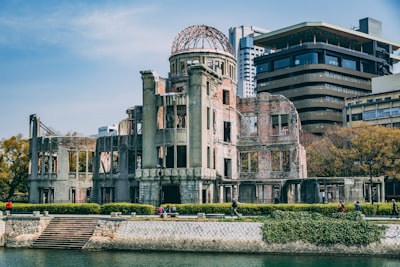
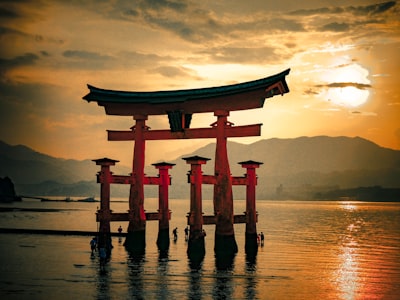
The Peace Memorial Park is in the same area as Okonomimura — a 10-minute walk west along the river. Most visitors combine Peace Memorial Park in the morning with okonomiyaki for lunch. This is the natural structure for a Hiroshima day: walk the park, visit the museum, eat okonomiyaki, continue to Miyajima in the afternoon.